
January 21, 2026
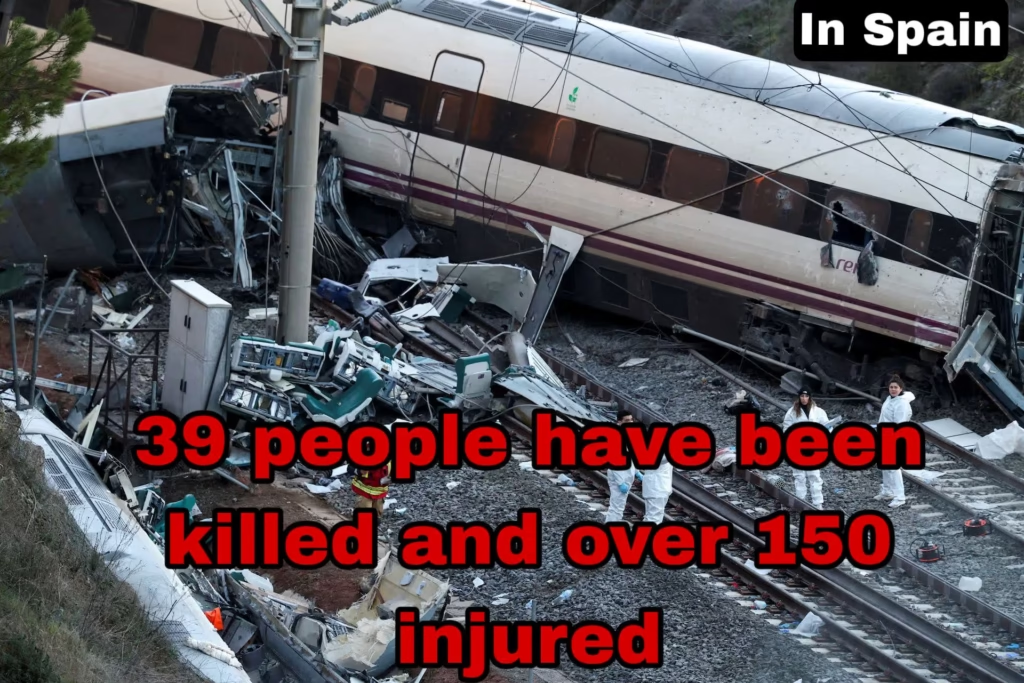
In a heartbreaking tragedy that has shaken Spain, a high-speed train accident near the town of Adamuz in Córdoba province has claimed at least 41 lives and injured over 120 others. The crash, which occurred on Sunday evening, January 19, 2026, involved two trains colliding after one derailed, marking the country’s worst rail disaster in over a decade. As rescue teams continue to sift through the wreckage, the nation mourns, with three days of national mourning declared. This incident raises urgent questions about rail safety in one of Europe’s most advanced high-speed networks
What Happened: A Fatal Derailment in Seconds
The accident unfolded around 7:45 PM local time on a seemingly routine stretch of track in southern Spain’s Andalusia region, about 360 km south of Madrid. A northbound Iryo-operated train, carrying around 300 passengers from Málaga to Madrid, suddenly derailed at approximately 110 km/h (68 mph). Its carriages crossed onto the opposite track, slamming into an oncoming Renfe train heading south from Madrid to Huelva at 200 km/h (124 mph). The impact was catastrophic, splitting one carriage in two and crushing the locomotive of the second train.
Survivors described the chaos as sudden and terrifying. “The train tipped to one side… then everything went dark, and all I heard was screams,” recounted Ana Garcia Aranda, a 26-year-old passenger who escaped with injuries but witnessed others who weren’t so lucky. The trains came to a halt about 500 meters apart, with debris scattered across the olive groves in this remote, hilly area. Emergency responders faced challenges accessing the site via a single-track road, but helicopters and over 200 rescuers worked through the night to pull people from the twisted metal.
Eyewitnesses like local resident Paqui, who rushed to help, painted a grim picture: “My husband found a dead child inside, another child calling for his mother. You’re never ready to see something like this.” The crash happened in just 20 seconds after the initial derailment, leaving little time for reaction.
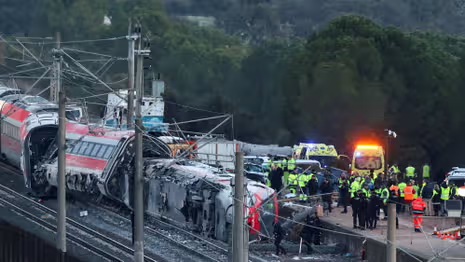
High-speed train crash in southern Spain kills 39 | Spain | Over 120 passengers injured
Casualties and Ongoing Rescue Efforts
As of January 20, 2026, the death toll stands at 41, with fears it could rise as cranes and heavy machinery clear the wreckage. One more body was discovered overnight, and 23 people remain missing, along with one dog reported by families. Among the injured, 123 have been treated, with 37 still hospitalized—12 in intensive care, including children. Four children were among those admitted, underscoring the human toll on families traveling for holidays or work.
Rescue operations continue amid emotional scenes. A Nicaraguan woman, Osiris Sevilla Madariaga, waits anxiously for news of her missing husband: “Until I see him with my own eyes, I can’t lose hope.” The Spanish Red Cross has set up support centers, providing counseling to relatives grappling with uncertainty. Over 200 trains to Andalusia have been canceled, disrupting travel for thousands.
- What Happened: A Fatal Derailment in Seconds
- Casualties and Ongoing Rescue Efforts
- A ‘Strange’ and Baffling Cause
- Eyewitness Accounts: Stories of Horror and Heroism
- Historical Context: Echoes of Past Tragedies
- Government and Royal Response: A Nation United in Grief
- Impact on Rail Travel and Safety Lessons
A ‘Strange’ and Baffling Cause
Authorities are probing what led to the derailment, with early findings pointing to a broken joint on the rails that created a widening gap. Ignacio Barron, head of Spain’s Commission of Investigation of Rail Accidents, emphasized that the focus is on the “interaction between the track and the vehicle.” Human error has been largely ruled out, as both trains were modern— the Iryo Frecciarossa 1000 was under four years old and last inspected on January 15.
Transport Minister Óscar Puente called the incident “extremely strange,” baffling railway experts. The line was renovated last May, but train drivers had warned of “severe wear and tear” on the Madrid-Andalusia route months earlier. Critics point to potential maintenance lapses amid Spain’s push for privatized high-speed rail, opened to competition in 2020. An full investigation could take at least a month, but initial reports suggest no negligence from operators.
National Mourning Declared

Spain’s Prime Minister Pedro Sánchez has declared three days of official national mourning in response to the tragedy and canceled international travel plans to be present at the crash site.

King Felipe VI and Queen Letizia have also returned to Spain to visit the victims and support rescuers and families.
Eyewitness Accounts: Stories of Horror and Heroism
From the front lines, journalist Salvador Jimenez, aboard one train, felt it like “an earthquake.” Passenger José recalled “people screaming, calling for doctors.” Fire chief Francisco Carmona described the grueling work: “We even had to remove a dead person to reach someone alive.”
Amid the tragedy, acts of heroism emerged. Locals like the “angel of Adamuz” were thanked by King Felipe VI and Queen Letizia for aiding rescues. One six-year-old girl became the sole survivor of her family, a miracle amid the devastation.
Historical Context: Echoes of Past Tragedies
This crash is Spain’s deadliest since the 2013 Santiago de Compostela derailment, where 80 died due to excessive speed. Spain boasts Europe’s largest high-speed network (over 3,600 km), second only to China globally, connecting over 50 cities. While accidents are rare, this event highlights vulnerabilities in even the most advanced systems. Compared to other European nations, Spain’s safety record is strong, but recent issues like power outages and cable thefts have raised concerns.
Government and Royal Response: A Nation United in Grief
Prime Minister Pedro Sánchez canceled international trips to focus on the crisis, vowing to “uncover the truth.” King Felipe VI and Queen Letizia visited the site and injured at Reina Sofía Hospital in Córdoba, offering condolences: “We extend our most heartfelt condolences to the relatives and loved ones.” International leaders, including French President Emmanuel Macron and EU chief Ursula von der Leyen, expressed solidarity.
Evangelical groups and communities have called for prayers, while police set up DNA identification offices for families.
Impact on Rail Travel and Safety Lessons
This tragedy disrupts Spain’s vital high-speed links, with services suspended between Madrid and Andalusia. It underscores the need for enhanced maintenance and technology, like advanced signaling systems that could prevent such interactions. As Spain invests in sustainable transport, experts call for balancing speed with safety to avoid future heartbreaks.
In times like these, the resilience of communities shines through. Our thoughts are with the victims, their families, and the brave rescuers. For updates on the Spain train crash 2026, stay tuned.
Keywords: Spain train crash 2026, high-speed train collision Spain, Adamuz train accident, Córdoba rail disaster, train derailment Spain
Author Profile

- Global Daily Post – Your Trusted Source for Global News & Updates
Globle Daily Post is a leading news platform that covers cricket news, automotive launches, gold silver rates, and international news in real-time.
Latest entries
 IndiaMarch 18, 2026Renault India 2026 Launch Expected Features Price Mileage & Full Details
- WorldMarch 12, 2026Is The Gulf Questioning US Security Guarantee? Rising Doubts Over America’s Role in Middle East Security
- IndiaMarch 7, 2026India vs New Zealand Final Press Conference Live Updates: How SKY Reacted to Santner’s Big Comment Before T20 World Cup Final
- IndiaMarch 7, 2026Future Will Be Much More Multipolar, Says S Jaishankar: India’s Vision for a Changing Global Order






Pingback: Sri Lanka vs England ODI Series 2026: Full Preview, Playing
Pingback: Trump Accuses Canada of Backing China Over Greenland Defen