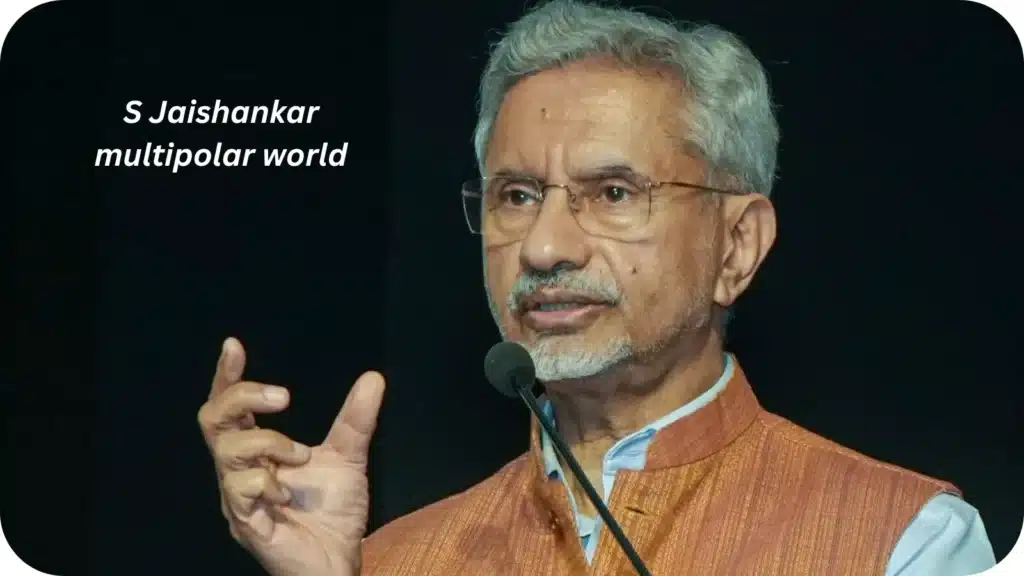
Future Will Be Much More Multipolar, Says S Jaishankar
India’s External Affairs Minister S Jaishankar multipolar world vision has once again drawn global attention after he stated that the future international system will be far more multipolar than what the world has seen in recent decades. Speaking at a major international forum, Jaishankar highlighted how global power dynamics are shifting rapidly, with several emerging economies and regional powers playing increasingly important roles in shaping the global order.
According to Jaishankar, the era when a single superpower dominated world politics is gradually fading. Instead, the world is witnessing the rise of multiple influential countries, each contributing to international decision-making in areas such as economics, security, technology, and climate policy.
His remarks reflect a broader shift in global geopolitics where countries like India, China, Brazil, and others are becoming more prominent voices on the international stage. For India in particular, the idea of a multipolar world aligns closely with its foreign policy strategy that emphasizes strategic autonomy, balanced diplomacy, and stronger partnerships across continents.
This evolving global landscape has major implications for international relations, economic alliances, and geopolitical stability in the coming decades.
- Future Will Be Much More Multipolar, Says S Jaishankar
- Understanding the Concept of a Multipolar World
- India’s Growing Role in a Multipolar Global Order
- Strategic Autonomy: India’s Core Foreign Policy Principle
- Changing Global Power Dynamics
- Role of Emerging Economies in Global Governance
- India’s Diplomatic Engagement in a Multipolar World
- Economic Implications of a Multipolar World
- Technology, Security and the New Global Competition
- Challenges of a Multipolar World
- Opportunities for India in the Multipolar Era
- Global Reactions to Jaishankar’s Multipolar World Vision
- FAQs
- Conclusion
Understanding the Concept of a Multipolar World
A multipolar world refers to a global system where power is distributed among several major countries rather than concentrated in one or two dominant states.
In the past century, the international system has gone through different phases:
| Period | Global Order | Key Powers |
|---|---|---|
| Pre-World War I | Multipolar | European empires |
| Cold War | Bipolar | United States and Soviet Union |
| Post-Cold War | Unipolar | United States |
| Emerging Era | Multipolar | US, China, India, EU, others |
Jaishankar believes that the 21st century will gradually move toward a multipolar structure, where global governance will involve cooperation among several major powers.
Why the World Is Becoming Multipolar
Several factors are contributing to this transformation:
- Rapid economic growth in emerging economies
- Expansion of regional political alliances
- Technological advancements across multiple countries
- Increased global trade and interconnected economies
- Changing military and security dynamics
Countries that were once considered developing economies are now playing a significant role in shaping international policies.
India’s Growing Role in a Multipolar Global Order
India’s rise as a global power is one of the key reasons why discussions about a multipolar world are gaining momentum.
Over the past two decades, India has significantly strengthened its influence in global politics, diplomacy, and economic cooperation.
Key factors behind India’s rising global influence
- One of the world’s fastest-growing major economies
- Strategic partnerships with multiple countries
- Leadership in global forums such as G20
- Expanding technological and digital ecosystem
- A strong and stable democratic political system
India’s diplomatic strategy focuses on maintaining balanced relations with major powers including the United States, Russia, Europe, and countries in the Indo-Pacific region.
Jaishankar has repeatedly emphasized that India does not see global politics as a zero-sum game. Instead, New Delhi believes cooperation among nations is essential to address global challenges.
Strategic Autonomy: India’s Core Foreign Policy Principle
One of the key ideas behind India’s diplomacy is strategic autonomy, a concept that allows the country to maintain independent decision-making without aligning permanently with any single global power.
Jaishankar has described strategic autonomy as an essential approach in a multipolar world.
What strategic autonomy means for India
- Freedom to make independent foreign policy decisions
- Maintaining relations with competing global powers
- Avoiding dependency on a single geopolitical bloc
- Focusing on national interest in global negotiations
This approach enables India to build strong partnerships with a wide range of countries while maintaining flexibility in global diplomacy.
Changing Global Power Dynamics
The global balance of power has been shifting steadily in recent decades.
Economic growth in Asia, technological competition, and regional political developments have all contributed to this transformation.
Key geopolitical trends shaping the multipolar world
- Rise of Asian economies
Countries in Asia are becoming major drivers of global economic growth. India, China, and Southeast Asian nations are expanding their influence in global trade and investment.
- New regional alliances
Groups like BRICS, QUAD, and regional economic partnerships are reshaping diplomatic relationships.
- Technology competition
Emerging technologies such as artificial intelligence, space exploration, and digital infrastructure are creating new areas of global competition.
- Energy and supply chain shifts
Countries are diversifying supply chains and energy partnerships to reduce dependence on single sources.
These trends suggest that global influence will increasingly be distributed among several powerful nations rather than concentrated in a single country.
Role of Emerging Economies in Global Governance
Emerging economies are becoming more active participants in international decision-making.
Organizations such as G20 have gained greater importance because they represent both developed and developing countries.
Jaishankar has highlighted that global governance institutions must adapt to reflect the new geopolitical reality.
Why reforms in global institutions are necessary
Many international organizations were established after World War II and reflect the political realities of that time.
However, the global power balance has changed significantly since then.
For example:
- Emerging economies contribute a larger share to global GDP
- Population and market size of developing nations have increased
- New geopolitical alliances have formed across continents
As a result, countries like India are advocating reforms in global institutions to ensure fair representation.
India’s Diplomatic Engagement in a Multipolar World
India has adopted an active diplomatic strategy to strengthen its global partnerships.
Jaishankar has emphasized that India seeks to build bridges across regions rather than align with exclusive blocs.
Major diplomatic initiatives by India
- Strengthening ties with Indo-Pacific nations
- Expanding partnerships in Africa and Latin America
- Promoting regional cooperation in South Asia
- Leading global discussions on climate and development
These initiatives demonstrate India’s commitment to playing a constructive role in the evolving international order.
Economic Implications of a Multipolar World
A multipolar global system will also reshape international trade and economic cooperation.
Countries are increasingly forming economic partnerships that support diversified growth and resilience.
Possible economic impacts
- Greater regional trade agreements
- Expansion of digital and technology partnerships
- Diversification of global supply chains
- Increased investment in emerging markets
India’s growing economy and large consumer market position it as a key participant in this transformation.
Technology, Security and the New Global Competition
Another major factor influencing the multipolar world is the rapid advancement of technology.
Countries are competing to lead in sectors such as:
- Artificial intelligence
- Semiconductor manufacturing
- Space technology
- Cybersecurity
- Renewable energy
These sectors will shape economic and military capabilities in the coming decades.
Jaishankar has pointed out that technology cooperation and competition will both play critical roles in defining the future global order.
Challenges of a Multipolar World
While a multipolar world may provide more balanced power distribution, it also presents certain challenges.
Potential risks
- Increased geopolitical competition
- Regional conflicts between emerging powers
- Complex diplomatic negotiations
- Economic fragmentation
Managing these challenges will require stronger international cooperation and diplomatic dialogue.
Opportunities for India in the Multipolar Era
Despite the challenges, the multipolar global system presents significant opportunities for India.
Key opportunities
- Greater influence in global decision-making
- Expanded trade and economic partnerships
- Leadership in global technology initiatives
- Stronger role in international diplomacy
India’s demographic advantage, technological growth, and strategic location in the Indo-Pacific region provide strong foundations for future leadership.
Global Reactions to Jaishankar’s Multipolar World Vision
Jaishankar’s remarks have resonated with many countries that support a more balanced international system.
Several nations believe that a multipolar structure can create a fairer and more inclusive global governance framework.
Many analysts argue that the transition toward multipolarity is already underway and will likely accelerate in the coming decades.
However, the pace and shape of this transition will depend on global cooperation, economic growth, and geopolitical stability.
FAQs
What does S Jaishankar mean by a multipolar world
A multipolar world refers to a global system where multiple countries share influence rather than one or two dominant powers controlling global politics.
Why is the world moving toward a multipolar system
Economic growth in emerging countries, technological advancements, and changing geopolitical alliances are contributing to the shift toward a multipolar world.
What role will India play in the multipolar world
India is expected to play a major role due to its growing economy, strategic location, diplomatic influence, and leadership in global forums.
How does strategic autonomy fit into India’s foreign policy
Strategic autonomy allows India to maintain independent decision-making while building partnerships with multiple global powers.
Will a multipolar world be more stable
It can create a balanced distribution of power, but it may also lead to increased geopolitical competition if cooperation among countries weakens.
Conclusion
External Affairs Minister S Jaishankar multipolar world vision reflects a major transformation taking place in international politics. The global system is gradually moving away from a single dominant power toward a structure where multiple countries influence global decisions.
This shift presents both opportunities and challenges for nations across the world. For India, however, the emergence of a multipolar world offers a chance to expand its global leadership and shape international policies in a meaningful way.
As economic growth, technological innovation, and geopolitical alliances continue to evolve, the coming decades are likely to redefine how nations cooperate and compete on the global stage.
India’s balanced diplomatic approach, emphasis on strategic autonomy, and growing global partnerships position it as one of the key players in the emerging multipolar order.
Excise Policy Case: Delhi Court Discharges Kejriwal, Sisodia, Kavitha; CBI to Appeal in High Cour
Author Profile

- Global Daily Post – Your Trusted Source for Global News & Updates
Globle Daily Post is a leading news platform that covers cricket news, automotive launches, gold silver rates, and international news in real-time.
Latest entries
 IndiaMarch 18, 2026Renault India 2026 Launch Expected Features Price Mileage & Full Details
- WorldMarch 12, 2026Is The Gulf Questioning US Security Guarantee? Rising Doubts Over America’s Role in Middle East Security
- IndiaMarch 7, 2026India vs New Zealand Final Press Conference Live Updates: How SKY Reacted to Santner’s Big Comment Before T20 World Cup Final
- IndiaMarch 7, 2026Future Will Be Much More Multipolar, Says S Jaishankar: India’s Vision for a Changing Global Order