
Discover how Europe and China take step to resolve dispute on electric vehicles through new guidance on minimum prices and voluntary commitments, easing tariffs and fostering fair competition in the EV market as of January 2026.
The electric vehicle (EV) sector has become a cornerstone of the global transition to sustainable energy. However, trade tensions between major economies have threatened this progress. Recently, Europe and China take step to resolve dispute on electric vehicles by announcing collaborative measures to address long-standing concerns over subsidies and market distortions. On January 12, 2026, the European Commission and China’s Ministry of Commerce released guidance that paves the way for alternatives to punitive tariffs, signaling a pragmatic approach to trade relations.
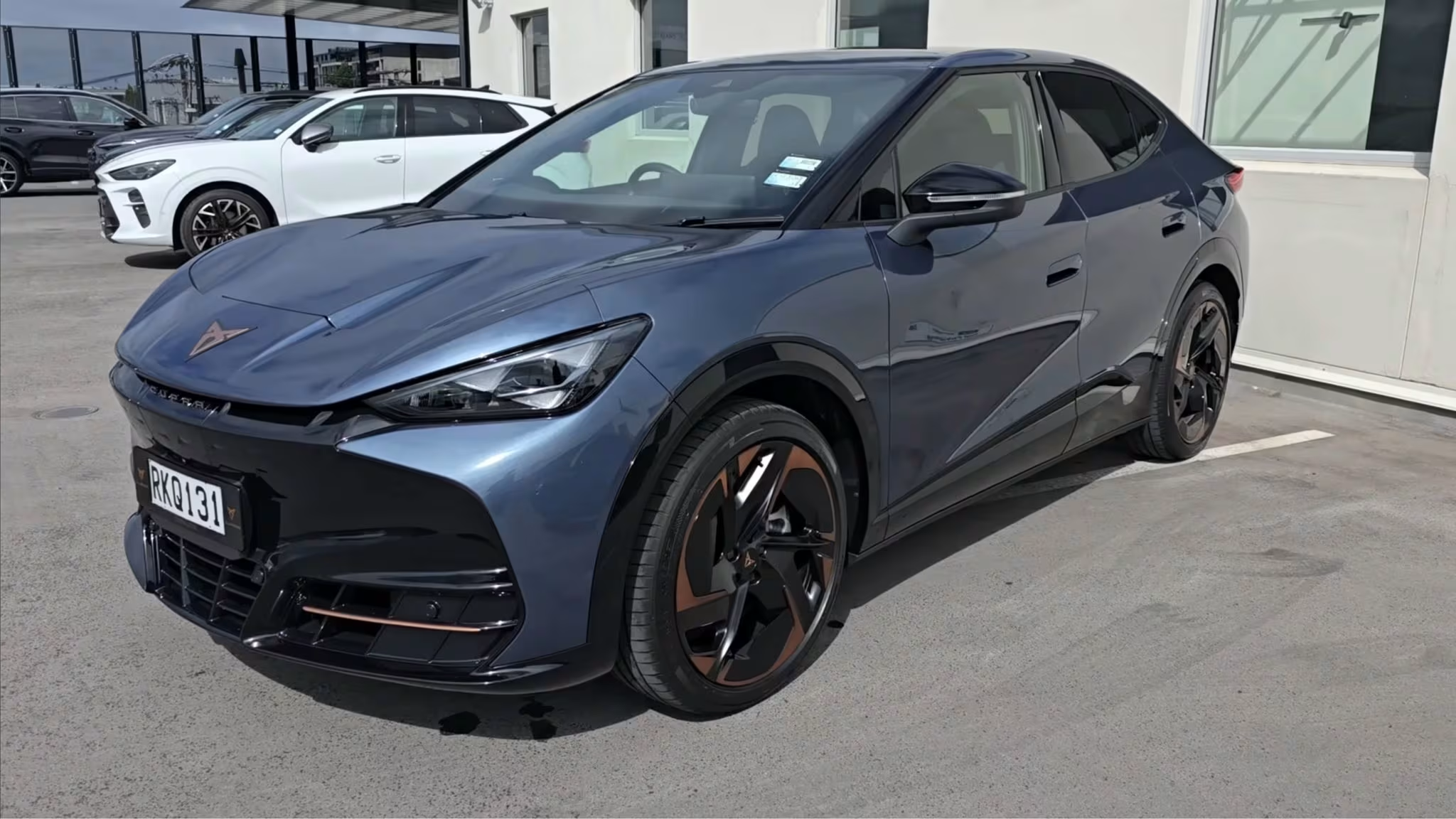
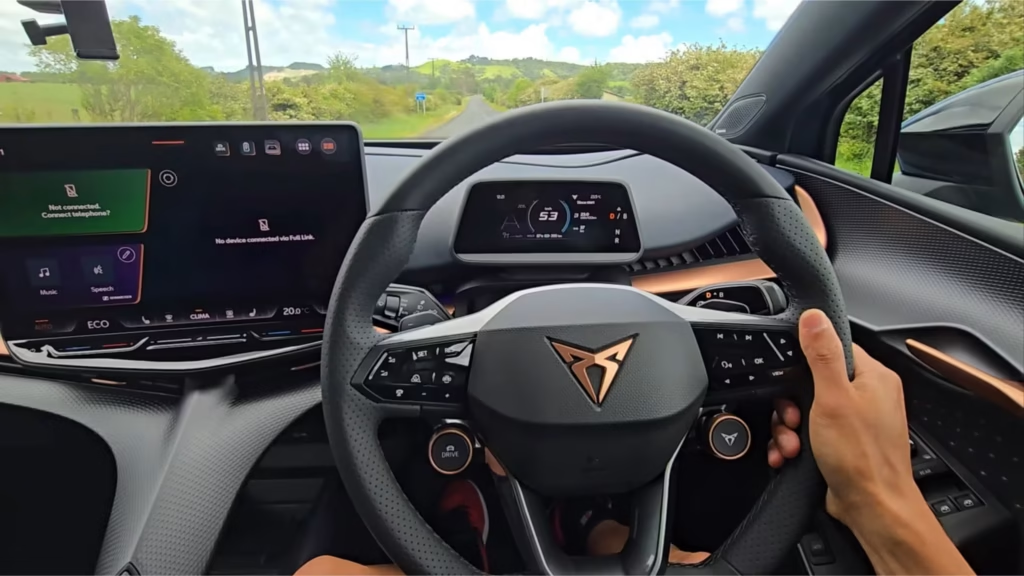
What is the Cupra Tavascan?
It’s a compact crossover SUV (C-segment) that’s 100% battery electric, built on Volkswagen Group’s MEB platform (the same architecture as the ID.3, ID.4, and others). Designed with a sporty, coupé-like sloping roofline for that aggressive look, it’s produced by Volkswagen Anhui — a joint venture in China between Volkswagen (75%) and JAC Group (25%). This Chinese manufacturing is key to recent trade developments.
Key specs include:
The of Electric Vehicles
| 1 General Motors | 2 Tesla sales | 3 Toyota Prius | 4 Scaling Back Production |
| The largest U.S. carmaker said it would record a $7.1 billion loss for the last quarter of 2025 | For the first year ever, Tesla | To industry experts, | both announced plans to reduce electric vehicle production, responding to a drop in sales and a reversal |
| primarily to reflect the diminished value of its investments | sold less cars than the Chinese automaker BYD, | the seeds of the politicalization of electric vehicles | General Motors and Ford |
| in battery factories and electric vehicle assembly lines. | as it suffered more than other U.S. carmakers from the elimination of federal incentives. | in government policies since President Trump took office. | |
Powertrain options: Rear-wheel drive (Endurance models) or all-wheel drive (VZ performance versions).
Battery: Typically a 77 kWh usable capacity (with an 82 kWh gross pack in some configs).
Range: Up to around 550 km (WLTP) in the most efficient variants, or about 520 km in the punchier VZ.
Performance: Top models deliver up to 340 hp (250 kW), with 0-100 km/h in under 6 seconds.
Pricing: Starts from roughly €44,000–€47,000 in Europe (depending on market and trim), positioning it as a premium yet accessible EV.
Background of the Europe-China Electric Vehicles Dispute
The roots of the dispute trace back to 2023 when the European Union launched an anti-subsidy investigation into battery electric vehicles (BEVs) imported from China. Brussels alleged that heavy state support in China allowed manufacturers to offer EVs at artificially low prices, harming European producers. After a year-long probe, the EU imposed countervailing tariffs ranging from 7.8% to 35.3% on Chinese BEV imports in October 2024, in addition to the standard 10% duty. These measures aimed to level the playing field but sparked retaliatory threats and negotiations.
China viewed the tariffs as discriminatory and protectionist, arguing they violated World Trade Organization (WTO) principles. The dispute escalated amid broader geopolitical shifts, including Europe’s push for strategic autonomy in clean tech and China’s dominance in EV battery supply chains. By 2025, talks intensified, with both sides exploring alternatives like minimum price commitments to replace outright duties.
Europe and China Take Step to Resolve Dispute on Electric Vehicles in 2026
The breakthrough came on January 12, 2026, when both parties issued a joint framework for resolution. The European Commission published a detailed guidance document outlining how Chinese EV exporters can submit “price undertaking offers.” These commitments involve setting minimum import prices for specific models and configurations to eliminate the injurious effects of alleged subsidies.
Key elements include:
- Minimum Price Mechanisms — Exporters must propose prices that match or exceed levels equivalent to the tariffs’ protective effect.
- Volume Limits and Investments — Offers can incorporate annual shipment quotas and details on future investments in the EU, which the Commission will consider favorably.
- Non-Discrimination and WTO Compliance — Assessments will be objective, fair, and aligned with international trade rules.
China’s Ministry of Commerce welcomed the move as a “positive example” of resolving differences through dialogue. The guidance reflects months of consultations, building on consensus from prior EU-China summits. This step demonstrates mutual willingness to avoid escalation while protecting domestic industries.
Implications for the Electric Vehicles Industry
Europe and China take step to resolve dispute on electric vehicles has immediate ramifications for stakeholders.
For Chinese manufacturers like BYD, NIO, and XPeng, the option to replace tariffs with price undertakings could lower costs and stabilize market access. It avoids the full burden of duties, potentially boosting exports while encouraging local production in Europe.
European automakers, including Volkswagen (which produces EVs in China), benefit significantly. Reports indicate the Commission is reviewing Volkswagen’s specific proposals for models like the Cupra Tavascan, allowing voluntary import limits in exchange for tariff relief. This hybrid approach supports companies with cross-border operations.
Consumers in Europe may see moderated price increases. While minimum prices prevent dumping, they could stabilize supply without the sharp hikes tariffs might cause. The EV transition accelerates as affordable, diverse options remain available.
Globally, this resolution strengthens supply chains. With China controlling much of battery production, cooperative trade prevents disruptions that could slow decarbonization efforts.
Challenges and Future Outlook
Despite progress, hurdles remain. The guidance requires thorough reviews of each offer, and not all may be accepted if they fail to fully offset subsidy impacts. Differences in vehicle types necessitate model-specific pricing, adding complexity.
Broader context includes external pressures, such as U.S. policies under evolving administrations and global competition in clean tech. Both sides must ensure commitments are monitored effectively to build trust.
Looking ahead, Europe and China take step to resolve dispute on electric vehicles could set a precedent for other sectors. Successful implementation might lead to deeper cooperation in joint R&D, battery recycling, and standards harmonization. It underscores that dialogue, rather than confrontation, best serves the urgent need for sustainable mobility.
In summary, the January 2026 announcement marks a constructive turn in EU-China relations. By prioritizing practical solutions like price undertakings and investment considerations, both regions advance fair competition while supporting the EV revolution. This balanced approach not only mitigates trade friction but also contributes to a greener, more interconnected global economy.
| Homepage | Click here |
| World | Click here |
| Union Bank Share Price | Click Here |
| Infosys Q3 Results | Click Here |
Author Profile

- Global Daily Post – Your Trusted Source for Global News & Updates
Globle Daily Post is a leading news platform that covers cricket news, automotive launches, gold silver rates, and international news in real-time.
Latest entries
 IndiaMarch 18, 2026Renault India 2026 Launch Expected Features Price Mileage & Full Details
- WorldMarch 12, 2026Is The Gulf Questioning US Security Guarantee? Rising Doubts Over America’s Role in Middle East Security
- IndiaMarch 7, 2026India vs New Zealand Final Press Conference Live Updates: How SKY Reacted to Santner’s Big Comment Before T20 World Cup Final
- IndiaMarch 7, 2026Future Will Be Much More Multipolar, Says S Jaishankar: India’s Vision for a Changing Global Order



Pingback: Hyundai Creta Electric Gets Massive ₹1.25 Lakh Discount — He