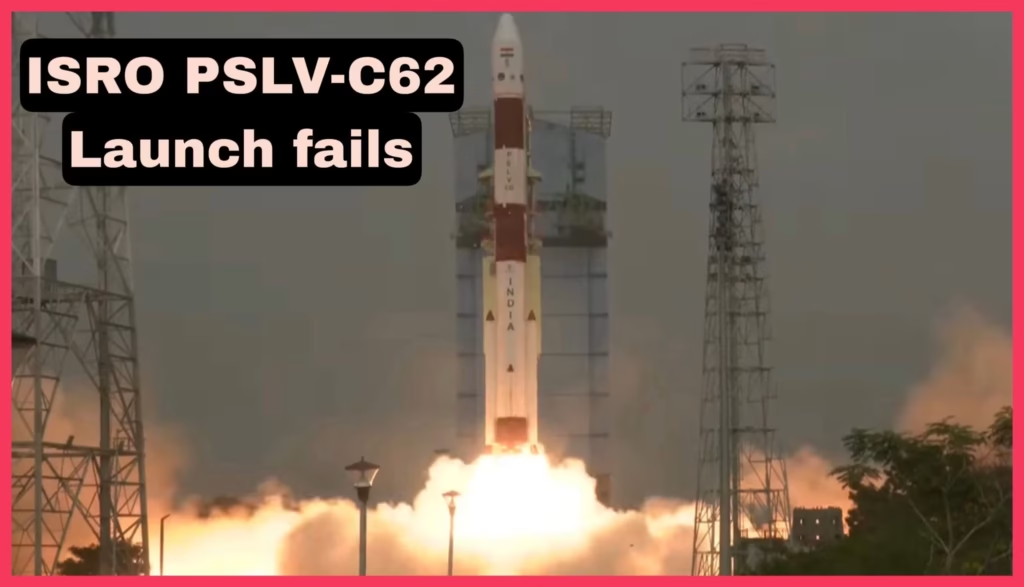
The ISRO PSLV-C62 mission launched in on January 12, 2026 was expected to further strengthen India’s reputation as a reliable spacefaring nation. The Polar Satellite Launch Vehicle (PSLV) has long been known as ISRO’s “workhorse,” with a strong success record across multiple missions. However, the PSLV-C62 mission failed after encountering a technical anomaly during the third stage (PS3) of the flight.
Background on ISRO’s PSLV Rocket and the C62 Mission
The PSLV, developed by ISRO in the 1990s, is a versatile four-stage rocket designed primarily for launching satellites into polar orbits. Known as India’s “workhorse” launcher, it has successfully deployed over 300 satellites for domestic and international clients, including notable missions like the Chandrayaan lunar probes and Mars Orbiter Mission. The PSLV’s reliability stems from its hybrid propulsion system: solid fuel in the first and third stages, liquid fuel in the second and fourth, allowing for precise orbital insertion
The PSLV-C62 mission was slated as India’s first space launch of 2026, lifting off from the Satish Dhawan Space Centre in Sriharikota. The primary payload, EOS-N1, was an advanced Earth observation satellite equipped with high-resolution imaging capabilities for applications in agriculture, disaster management, and urban planning. Accompanying it were 15 smaller satellites from various Indian startups and educational institutions, aimed at testing technologies like IoT connectivity and space-based AI. The mission’s objectives aligned with ISRO’s push towards commercializing space activities, with a total payload mass exceeding 1,200 kg.
- Background on ISRO’s PSLV Rocket and the C62 Mission
- The Launch Timeline: From Liftoff to Anomaly
- Technical Reasons Behind the PSLV-C62 Failure
- Comparing PSLV-C62 with Previous Failures
- Implications of the PSLV-C62 Mission Failure for ISRO
- ISRO’s Response and Future Steps After PSLV-C62 Failure
- Conclusion: Lessons from the ISRO PSLV-C62 Mission Failure
Preparations for PSLV-C62 appeared routine, with pre-launch checks confirming all systems were nominal. The rocket’s configuration was standard for the PSLV-XL variant, featuring strap-on boosters for enhanced thrust. However, this launch came on the heels of the PSLV-C61 failure in May 2025, which also involved issues in the third stage, sparking concerns about recurring problems in the PSLV fleet.
Mission Details
- Launch Vehicle: Polar Satellite Launch Vehicle (PSLV-C62)
- Launch Year: 2026
- Mission Objective: Satellite deployment into SSO
- Launch Site: Sriharikota, Andhra Pradesh
- Mission Outcome: Failure due to PS3 anomaly
Despite a nominal liftoff and stable performance in the initial stages, the mission failed when the rocket experienced problems during the third stage (PS3)
The Launch Timeline: From Liftoff to Anomaly
The PSLV-C62 mission commenced at approximately 10:18 AM IST on January 12, 2026, under clear skies at Sriharikota. The initial phases proceeded flawlessly: the first stage ignited, propelling the rocket skyward with its solid propellant motors. Strap-on boosters separated as planned, and the second stage’s liquid engines took over, maintaining a steady ascent.
By the 200-second mark, the third stage (PS3), a solid-fuel motor, activated to provide the crucial thrust needed for higher altitude gains. Telemetry data initially showed normal performance, with chamber pressure holding steady. However, towards the end of the PS3 burn—around 203 seconds into the flight—an unexpected disturbance emerged. ISRO mission control detected a sharp drop in chamber pressure, accompanied by irregular roll rates that caused the vehicle to deviate from its predetermined flight path.
Live feeds from onboard cameras captured the rocket tumbling slightly, a visual confirmation of the instability. Telemetry updates ceased shortly after, indicating a loss of control. Without sufficient thrust, the fourth stage could not ignite properly, preventing the satellites from reaching their sun-synchronous orbit at about 500 km altitude. ISRO Chairman V. Narayanan addressed the media roughly 50 minutes post-launch, confirming the anomaly and stating that a detailed analysis was underway.
This sequence of events unfolded in under 10 minutes, transforming what started as a promising mission into a disappointment. The satellites, including EOS-N1, were likely lost or placed in a useless sub-orbital trajectory, representing a financial loss estimated in the crores and a setback for the involved partners.
| Reasons: Solid motors cannot be restarted or throttled The velocity loss was beyond correction limits PS4 requires precise entry conditions to function effectively Once the vehicle deviated from its planned trajectory, orbital insertion became impossible, leading to mission failure. | |
| launch fails Click here |
Technical Reasons Behind the PSLV-C62 Failure
At the heart of the PSLV-C62 failure lies the third-stage anomaly, specifically a “drop in chamber pressure” within the PS3 solid motor. Solid rocket motors like PS3 are pre-loaded with propellant and ignite in a controlled burn, but they lack the throttleability of liquid engines, making them susceptible to manufacturing defects or material inconsistencies.
Experts suggest the pressure drop could stem from several factors: a propellant grain crack, nozzle erosion, or a faulty igniter. Such issues reduce combustion efficiency, leading to insufficient thrust and vehicle instability. The resulting roll rate disturbance—essentially uncontrolled spinning—exacerbated the deviation, as the rocket’s guidance system struggled to compensate.
This isn’t an isolated incident; the PSLV-C61 mission in May 2025 suffered a similar fate, with a “mechanical glitch” in the third stage causing thrust shortfall. Preliminary investigations into C61 pointed to a “slight manufacturing error,” possibly in the solid propellant formulation or casing assembly. If the same supplier or batch of components was used for C62, it could indicate a systemic quality control lapse at ISRO’s Vikram Sarabhai Space Centre (VSSC), where PSLV stages are assembled.
Environmental factors, such as humidity during storage or vibrations during transport, might also play a role in degrading solid propellants. However, ISRO’s rigorous testing protocols typically mitigate these risks. The Failure Analysis Committee (FAC), now probing C62, will likely scrutinize telemetry data, onboard sensor logs, and recovered debris—if any—to pinpoint the root cause.
Comparing PSLV-C62 with Previous Failures
The PSLV series has seen only a handful of failures in its history, with the last major one being PSLV-C39 in 2017 due to a heat shield separation issue. The back-to-back failures of C61 and C62 are unprecedented, raising alarms about the rocket’s maturing design. Both recent incidents targeted Earth observation missions, potentially delaying ISRO’s remote sensing programs.
In contrast to liquid-stage failures, which can sometimes be corrected mid-flight, solid-stage problems are instantaneous and irreversible. This vulnerability underscores the need for enhanced non-destructive testing methods, like X-ray imaging of propellant grains, to detect anomalies pre-launch.
Globally, similar issues have plagued other launchers; for instance, NASA’s Space Shuttle experienced solid booster challenges in the Challenger disaster. ISRO can draw lessons from these, perhaps collaborating with international agencies to refine its solid propulsion technology.
Implications of the PSLV-C62 Mission Failure for ISRO
The failure of PSLV-C62 carries multifaceted implications. Financially, the mission cost around ₹200 crore, plus the value of the lost satellites. For startups relying on these rideshares, the setback could hinder funding and innovation in India’s nascent space sector.
Reputationally, two consecutive PSLV failures might erode confidence among international clients, who have increasingly turned to ISRO for affordable launches. This comes at a time when competitors like SpaceX and China’s Long March series are dominating the market. Domestically, it could invite scrutiny from policymakers, potentially affecting budgets for upcoming projects like Gaganyaan or Aditya-L1 follow-ups.
On a positive note, failures often catalyze improvements. ISRO’s track record shows quick recoveries; after the 2017 failure, the agency achieved a string of successes. The organization may accelerate the transition to next-generation launchers like the Small Satellite Launch Vehicle (SSLV) or enhance PSLV with redundant systems.
ISRO’s Response and Future Steps After PSLV-C62 Failure
In the wake of the anomaly, ISRO swiftly formed the FAC to investigate. Chairman Narayanan emphasized transparency, promising updates as data is analyzed. Potential fixes could include reformulating propellants, upgrading quality assurance, or incorporating advanced sensors for real-time monitoring.
Looking ahead, ISRO has a packed 2026 schedule, including GSLV missions and international collaborations. By addressing the third-stage vulnerabilities, the agency can restore PSLV’s reliability and continue advancing India’s space goals. Community reactions on platforms like Reddit highlight public support mixed with concern, urging ISRO to prioritize safety over speed.
Conclusion: Lessons from the ISRO PSLV-C62 Mission Failure
The PSLV-C62 failure serves as a stark reminder that space exploration is fraught with risks, even for proven systems. While the third-stage pressure drop and resulting deviation thwarted the mission, it also presents an opportunity for ISRO to innovate and strengthen its capabilities. As India aims for lunar bases and manned missions, overcoming such hurdles will be key to long-term success.
In summary, the reasons why the ISRO PSLV-C62 mission failed boil down to a technical glitch in the PS3 stage, echoing prior issues and demanding rigorous fixes. With ISRO’s history of perseverance, the future remains bright for India’s space endeavors.
Author Profile

- Global Daily Post – Your Trusted Source for Global News & Updates
Globle Daily Post is a leading news platform that covers cricket news, automotive launches, gold silver rates, and international news in real-time.
Latest entries
 IndiaMarch 18, 2026Renault India 2026 Launch Expected Features Price Mileage & Full Details
- WorldMarch 12, 2026Is The Gulf Questioning US Security Guarantee? Rising Doubts Over America’s Role in Middle East Security
- IndiaMarch 7, 2026India vs New Zealand Final Press Conference Live Updates: How SKY Reacted to Santner’s Big Comment Before T20 World Cup Final
- IndiaMarch 7, 2026Future Will Be Much More Multipolar, Says S Jaishankar: India’s Vision for a Changing Global Order