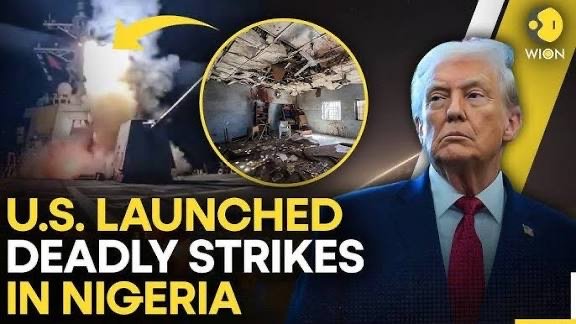
US Launches Strikes Against Islamic State in Nigeria: A Bold Move in West Africa’s Fight Against Terrorism
A Turning Point in the Battle Against Extremism
. This operation, dubbed a “powerful and deadly strike” by President Donald Trump himself, targeted hidden ISIS camps in Sokoto State, resulting in the confirmed deaths of multiple high-value terrorists.
For years, Nigeria has been a hotspot for jihadist insurgencies, with groups like the Islamic State’s West Africa Province (ISWAP) sowing chaos across the Sahel region. But why now? And what does this mean for the fragile balance of power in one of Africa’s most populous nations? As the world grapples with the resurgence of ISIS affiliates far from the caliphate’s former heartlands in Iraq and Syria, this US intervention signals a renewed commitment to preempting threats before they metastasize. In this in-depth exploration, we’ll unpack the strikes, their backstory, and the ripple effects that could reshape counterterrorism strategies for years to come.
The Immediate Impact: What Happened in Sokoto State?
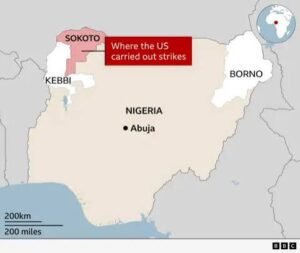
When news broke on Christmas Day, it sent shockwaves through international headlines. According to the U.S. Africa Command (AFRICOM), the strikes were carried out using a combination of drone surveillance and airstrikes, honed from years of operations in more familiar theaters like Afghanistan and Somalia. The targets? Insurgent training camps nestled in the rugged terrain of Sokoto State, a northwestern Nigerian province bordering Niger and Burkina Faso—prime territory for cross-border jihadist movements.
Initial assessments from AFRICOM indicate that at least a dozen ISIS operatives were neutralized, including mid-level commanders suspected of orchestrating recent attacks on Christian communities and military outposts. Eyewitness accounts from local villagers, shared via social media and corroborated by Nigerian security forces, described low-flying aircraft and explosions that lit up the night sky around 2 a.m. local time. “It was like thunder from the gods,” one anonymous resident told Reuters, capturing the surreal blend of fear and relief in a region long terrorized by these groups.
This wasn’t a haphazard raid; it was meticulously planned. Intelligence gathered over months—likely from a fusion of satellite imagery, human sources on the ground, and signals intercepts—pinned down the militants’ locations with surgical precision. The operation’s success underscores the technological edge the U.S. brings to such partnerships, but it also raises questions about collateral damage. While AFRICOM reports no civilian casualties, independent monitors like Amnesty International have called for transparent investigations to verify these claims, a common refrain in modern drone warfare.
Precision Over Payload: The Tech Behind the US Strikes
Diving deeper into the mechanics, the strikes exemplify the evolution of U.S. counterterrorism tactics. MQ-9 Reaper drones, armed with Hellfire missiles, were likely the workhorses here, capable of loitering for up to 27 hours while feeding real-time video to operators thousands of miles away in Creech Air Force Base, Nevada. This remote precision minimizes U.S. boots-on-the-ground risks, a doctrine refined post-Benghazi and amplified under Trump’s “America First” lens on foreign entanglements.
Yet, the human element can’t be overlooked. Nigerian special forces provided on-the-ground support, turning this into a true joint operation. President Bola Tinubu’s administration hailed it as a “decisive blow against terrorism,” crediting the collaboration for its effectiveness. In a statement released hours after the strikes, Tinubu emphasized, “This partnership with our American allies reaffirms Nigeria’s resolve to eradicate these scourges from our soil.”
Historical Context: ISIS’s Grip on Nigeria and the Sahel
To understand why the US launches strikes against Islamic State in Nigeria feels like a seismic shift, we must rewind the clock. The Islamic State in West Africa Province (ISWAP) emerged around 2015 as a splinter from Boko Haram, the infamous group behind the 2014 Chibok schoolgirls kidnapping. While Boko Haram’s brutality shocked the world, ISWAP’s strategy was more insidious: blending ideological fervor with sophisticated governance in ungoverned spaces, much like ISIS’s playbook in Syria.
By 2025, ISWAP had ballooned into a transnational menace, controlling swaths of territory along the Lake Chad Basin and extending tentacles into neighboring Mali, Niger, and Chad. Their attacks have evolved from crude bombings to coordinated assaults on soft targets—markets, churches, and convoys—exploiting ethnic and religious fault lines. In Nigeria alone, the Council on Foreign Relations estimates over 35,000 deaths since 2009, with economic sabotage like oil pipeline disruptions costing billions.
The Sahel’s instability isn’t just a Nigerian problem; it’s a powder keg fueled by climate change, poverty, and weak state institutions. Herder-farmer conflicts in the north, exacerbated by desertification, create fertile recruiting grounds for extremists promising justice and resources. Enter the U.S.: Historically cautious in Africa beyond counter-LRA ops in Uganda, Washington’s posture shifted post-2017 with the creation of AFRICOM’s counter-ISIS task forces. But direct strikes? Rare until now.
Trump’s Rhetoric: From Warnings to Action
President Trump’s role in greenlighting these strikes can’t be overstated. In the weeks leading up to Christmas, his social media barrages painted a dire picture: “ISIS scum in Nigeria are butchering Christians like it’s open season. Time for America to step up—bigly!” This wasn’t mere bluster; it echoed his November 2024 directive to the Pentagon to prepare “robust options” for Nigerian intervention, citing intelligence on imminent plots against U.S. interests, including embassies and expatriate oil workers.
Critics, including some in Congress, decry this as unilateral adventurism, harking back to Iraq 2003. Supporters, however, point to Trump’s track record—100% defeat of ISIS’s territorial caliphate by 2019—as vindication. In a PBS interview post-strikes, Trump doubled down: “We hit them hard, and we’ll hit them again if they so much as twitch. No more kid gloves for these animals.”
Nigeria’s Perspective: Partnership or Paternalism?
From Lagos to Abuja, reactions have been a mix of gratitude and guarded optimism. Nigeria’s military, stretched thin by multi-front insurgencies, welcomes the firepower. The strikes come at a pivotal moment: Just last month, ISWAP claimed responsibility for a suicide bombing in Kaduna that killed 42, prompting Tinubu to declare a “state of emergency” in the northwest.
Yet, beneath the alliance lies tension. Nigerian nationalists bristle at perceptions of foreign overreach, recalling colonial-era interventions. “We appreciate the help, but this is our fight,” opined retired General Tukur Buratai, former Chief of Army Staff, in a BBC op-ed. Economically, the strikes could boost investor confidence in Nigeria’s oil-rich north, where insecurity has deterred billions in FDI. The Nigerian National Petroleum Corporation (NNPC) reported a 15% uptick in exploration permits post-announcement, signaling market bets on stabilization.
On the humanitarian front, the operation dovetails with U.S. aid packages—$500 million pledged in 2025 for deradicalization programs and refugee support. But experts warn that bombs alone won’t win hearts. “Military wins must pair with development,” argues the Brookings Institution’s Africa director, emphasizing education and job creation to undercut ISWAP’s appeal among youth.
Regional Ramifications: A Domino Effect in the Sahel?
Zooming out, these strikes could trigger a cascade across the Sahel. Jihadist networks thrive on mobility; neutralizing Sokoto camps disrupts supply lines to Mali’s JNIM (Jama’at Nasr al-Islam wal-Muslimin), an al-Qaeda affiliate often clashing with ISIS rivals. France’s 2022 withdrawal from Operation Barkhane left a vacuum, and while the G5 Sahel Joint Force persists, it’s under-resourced.
For the U.S., this is part of a broader pivot: From Middle East quagmires to African hotspots, where China and Russia’s Wagner Group (now Africa Corps) vie for influence via mercenary deals with juntas in Mali and Niger. Trump’s strikes signal to adversaries: America’s not out. To allies like the UK and EU, who committed €1 billion to Sahel stability last year, it’s a call for burden-sharing.
But risks abound. Retaliatory attacks are likely; ISWAP’s propaganda arm already vowed “rivers of blood” on Telegram channels. Border communities in Niger could face spillover violence, straining UNHCR’s 1.2 million refugee caseload.
Expert Voices: Weighing the Pros and Cons
To cut through the noise, let’s hear from those on the frontlines. Dr. Freedom Onuoha, a terrorism expert at Nigeria’s Centre for Democracy and Development, views the strikes as “a necessary evil.” In an exclusive chat with Al Jazeera, he noted, “ISWAP’s decentralization makes them resilient, but decapitating leadership buys time for local forces to regroup.” Onuoha advocates for hybrid approaches: Drones for kills, community dialogues for prevention.
Conversely, Human Rights Watch’s Africa director, Ida Sawyer, cautions against escalation. “Targeted killings save lives short-term but breed resentment long-term,” she told The New York Times. Sawyer points to Somalia, where U.S. strikes inadvertently boosted al-Shabaab recruitment. Data from the Armed Conflict Location & Event Data Project (ACLED) supports this: Post-strike violence spikes in 60% of cases.
Militarily, retired U.S. General Stephen Townsend, ex-AFRICOM commander, praises the op’s execution. “Clean, quick, and collaborative—textbook,” he said on CNN. Townsend, who oversaw similar ops against Boko Haram in 2019, stresses intel-sharing as key: “Nigeria’s the eyes; we’re the sword.”
Global Counterterrorism: Lessons from Nigeria’s Theater
This episode offers a masterclass in adapting to “forever wars” 2.0. Unlike Syria’s urban battles, Nigeria’s fight is asymmetric—guerrillas in deserts, not armies in trenches. The U.S. strikes highlight innovations like AI-driven threat modeling, where algorithms sift petabytes of data to predict attacks.
Internationally, it bolsters the UN’s Global Counter-Terrorism Strategy, emphasizing prevention over reaction. Yet, funding gaps persist: The UN’s Sahel Trust Fund is only 40% met for 2025. For donors, Nigeria’s case is a litmus test—will strikes translate to sustained investment?
Conclusion: Toward a Safer Horizon?
As smoke clears over Sokoto, the US launches strikes against Islamic State in Nigeria stands as a stark chapter in the endless saga of extremism. It’s a victory for precision warfare and bilateral ties, but a reminder that terrorism’s roots run deep—nurtured by inequality, ideology, and neglect.
For Nigeria, the path forward demands more than missiles: Inclusive governance, economic revitalization, and youth empowerment to starve the insurgency. For the U.S., it’s about calibrating power—projecting strength without overstay. In Trump’s words, “We ended the caliphate once; we’ll do it again, wherever they hide.”
The world watches, hoping this Christmas gift of security endures beyond the holidays. Only time—and concerted global action—will tell if these strikes herald peace or just another skirmish in the long war.
Author Profile

- Global Daily Post – Your Trusted Source for Global News & Updates
Globle Daily Post is a leading news platform that covers cricket news, automotive launches, gold silver rates, and international news in real-time.
Latest entries
 IndiaMarch 18, 2026Renault India 2026 Launch Expected Features Price Mileage & Full Details
- WorldMarch 12, 2026Is The Gulf Questioning US Security Guarantee? Rising Doubts Over America’s Role in Middle East Security
- IndiaMarch 7, 2026India vs New Zealand Final Press Conference Live Updates: How SKY Reacted to Santner’s Big Comment Before T20 World Cup Final
- IndiaMarch 7, 2026Future Will Be Much More Multipolar, Says S Jaishankar: India’s Vision for a Changing Global Order